greenvissage

Expat Tax India

Managing Expat Taxes in India Starts the Day You Land.

Residential Status. Salary Structuring. Shadow Payroll. FEMA. Departure Planning.

Wrong residency determination. Incorrectly structured salary. A departure handled without tax clearance. We help employers and expatriate employees manage tax and compliance obligations from arrival through departure.


One Wrong Call at the Start Creates Problems That Last the Entire Assignment.

It often begins with residential status. If it is assessed incorrectly, tax obligations, payroll treatment, reporting requirements, and compliance responsibilities may all be affected. For employers, the implications extend beyond the employee.

Expat tax in India is rarely about a single compliance requirement. Tax, FEMA, payroll, social security, and employment considerations often overlap, and decisions made in one area can have consequences in another. Managing these obligations separately can lead to missed requirements, duplicated effort, and issues that surface much later in the assignment. Greenvissage helps employers and expatriate employees manage these obligations throughout the assignment lifecycle, from arrival planning through departure.

Services

Our Expat Tax Services

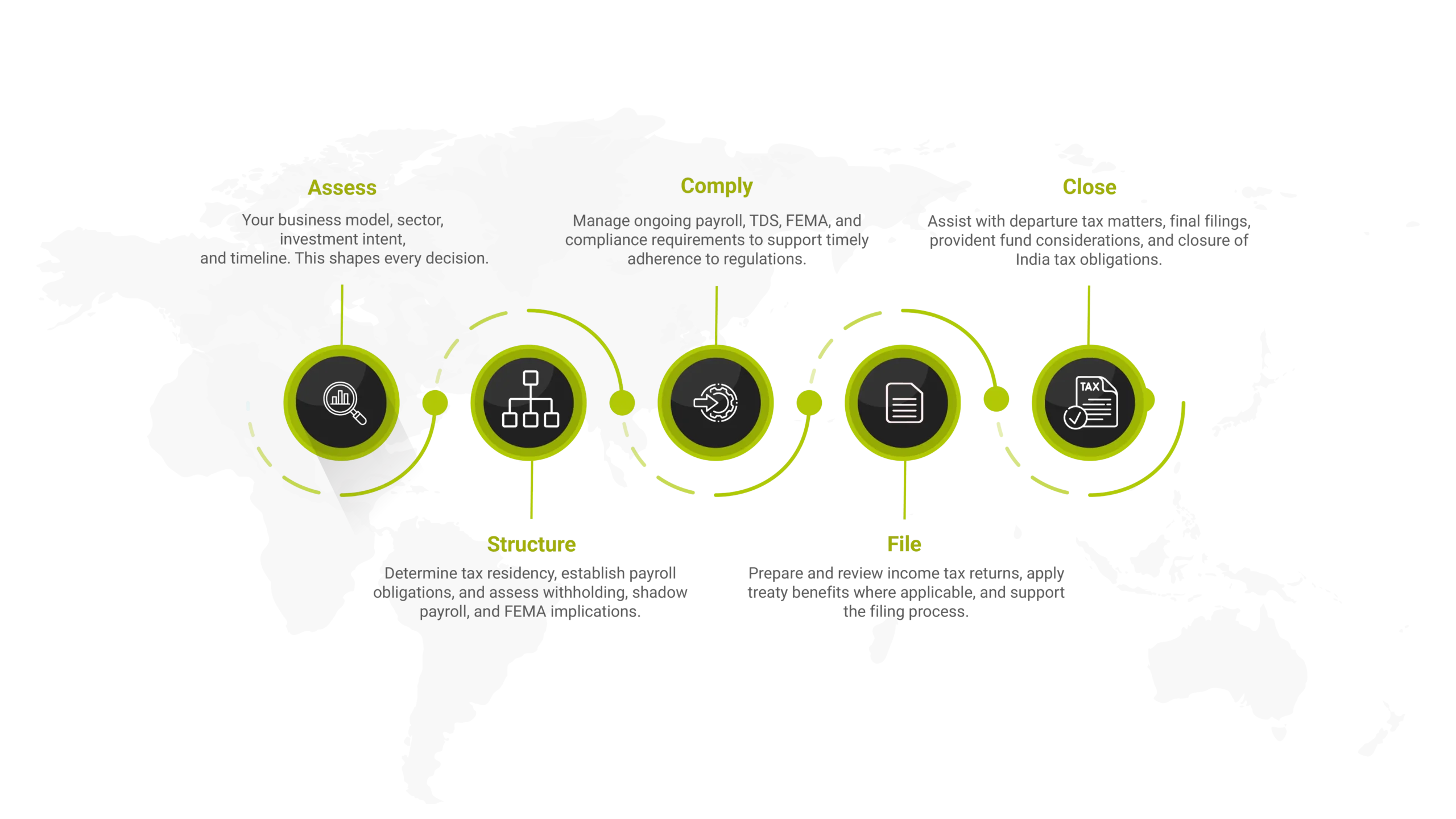
Expat assignments create tax, payroll, regulatory, and reporting obligations at different stages of the employee lifecycle. We support both employers and expatriate employees from assignment planning through final departure.

Assignment Planning & Structuring

risk-management

Residential Status Determination

Residential status influences taxability, filing obligations, treaty benefits, and FEMA considerations. We assess residential status under the Income-tax Act and applicable tax treaties, and help identify the resulting tax and compliance implications before the assignment begins.
analysis

Salary Structuring & Tax Equalisation

Designing compensation structures that are tax-efficient in India while remaining aligned with the company’s global mobility policies. Where tax equalisation applies, we assist with hypothetical tax calculations, actual tax computations, and employer cost assessments.
transference

Secondment & Deputation Agreement Support

Drafting and reviewing secondment agreements, deputation letters, and inter-company arrangements to appropriately reflect employment relationships, cost allocation, and tax treatment in India.

Mobility & Exit Support

inspection

Social Security Agreement Advisory

Assessing the applicability of Social Security Agreements (SSAs), reviewing eligibility for exemptions, and assisting with certificate of coverage requirements to help avoid unnecessary or duplicate social security contributions.
property

Departure & Exit Tax Planning

Supporting the final stages of an assignment through departure tax reviews, final return filings, tax clearance requirements, provident fund withdrawal considerations, and closure of India tax obligations.

Payroll & Compliance

Payroll Withholding & TDS

Monthly tax withholding calculations, challan payments, quarterly return filings, and TDS certificate issuance for expatriate employees, managed from the start of the assignment.

India Tax Return Filing

Preparation and filing of Indian income tax returns for expatriate employees, including residency analysis, treaty application, and review of assignment-related tax implications.

Shadow Payroll

Supporting employers whose expatriate employees remain on a home-country payroll while working in India.

FEMA Compliance

Advising on FEMA-related requirements associated with expatriate assignments, including remittances, reporting obligations, and regulatory compliance considerations that may arise during the assignment.

How We Evaluate Cross-Border Transactions.

FAQs

Still Have Questions?

Helping businesses navigate challenges, seize opportunities, and build a stronger future.

Residential status under the Income-tax Act is primarily determined by the number of days spent in India during the relevant tax year and preceding years. It affects the scope of income taxable in India, filing obligations, and the availability of certain tax treaty benefits. An incorrect determination can affect multiple aspects of an expatriate employee’s India tax position.

Tax equalisation ensures an expat neither gains nor loses financially because of the India tax environment. The company bears the actual India tax, while the employee bears a hypothetical tax equivalent to what they would have paid in their home country. Not every company applies tax equalisation, but without a clear policy, expatriate employees may face unexpected tax liabilities.

When an expat remains on a home-country payroll but works in India, a shadow payroll computes the India tax liability on that compensation and helps ensure correct withholding without actually paying the employee through an India payroll. It is commonly required where India tax obligations exist, but the employment arrangement remains offshore.

Filing requirements depend on factors such as residential status, the nature of income earned, applicable tax treaties, and statutory thresholds. Even where treaty relief is available, a tax return may still be required to formally claim the benefit. We assess filing obligations as part of the engagement and advise on the appropriate compliance requirements.

Foreign nationals working in India may be required to contribute to the Employees’ Provident Fund unless a Social Security Agreement exemption applies. Where contributions have been made, withdrawal on departure is subject to specific rules and procedures. We assist with both SSA exemption assessments and PF withdrawal requirements, where applicable, at the end of the assignment.

Your Expats Came to India to Work. Not to Navigate Its Tax System.

Let us manage the India tax, payroll, and compliance requirements that support the assignment, so your team can focus on the work that brought them here.

Residential Status · Salary Structuring · Shadow Payroll · Tax Returns · FEMA · Departure Planning

Have a Question?