

Financial Reporting & mis
Know What Your Numbers Mean
Financial reports that are accurate, timely, and built for decisions — not just compliance
Numbers That Actually Tell You Something.
Financial Reporting
MIS — Management Information System
Financial Reporting tells you what happened. MIS tells you what it means and what needs attention.
Everything You Need to See.
Two clear sets of outputs — one for compliance, one for decisions.
MIS Outputs
- Budget vs. actual analysis
- Revenue breakdown by product, client, or region
- Expense analysis — fixed vs variable, trend over months
- Gross margin and net margin tracking
- Working capital summary
- Receivables & payables ageing
- Department or cost centre wise P&L
- Client or project wise profitability
- Key financial ratios — debtor days, creditor days, burn rate
- Monthly management report

Financial Reporting Outputs
Profit & Loss statement
Balance sheet
Cash flow statement
Trial balance
Payables summary
Receivables summary
Notes to accounts
Not a Tally Export. An Actual Management Tool.
Most businesses already have accounting software. What they don’t have is someone converting that data into something leadership can use.
A Greenvissage MIS is
Built for the People Making Decisions.
A good MIS serves different people in different ways. Here’s who uses it and what they get from it.
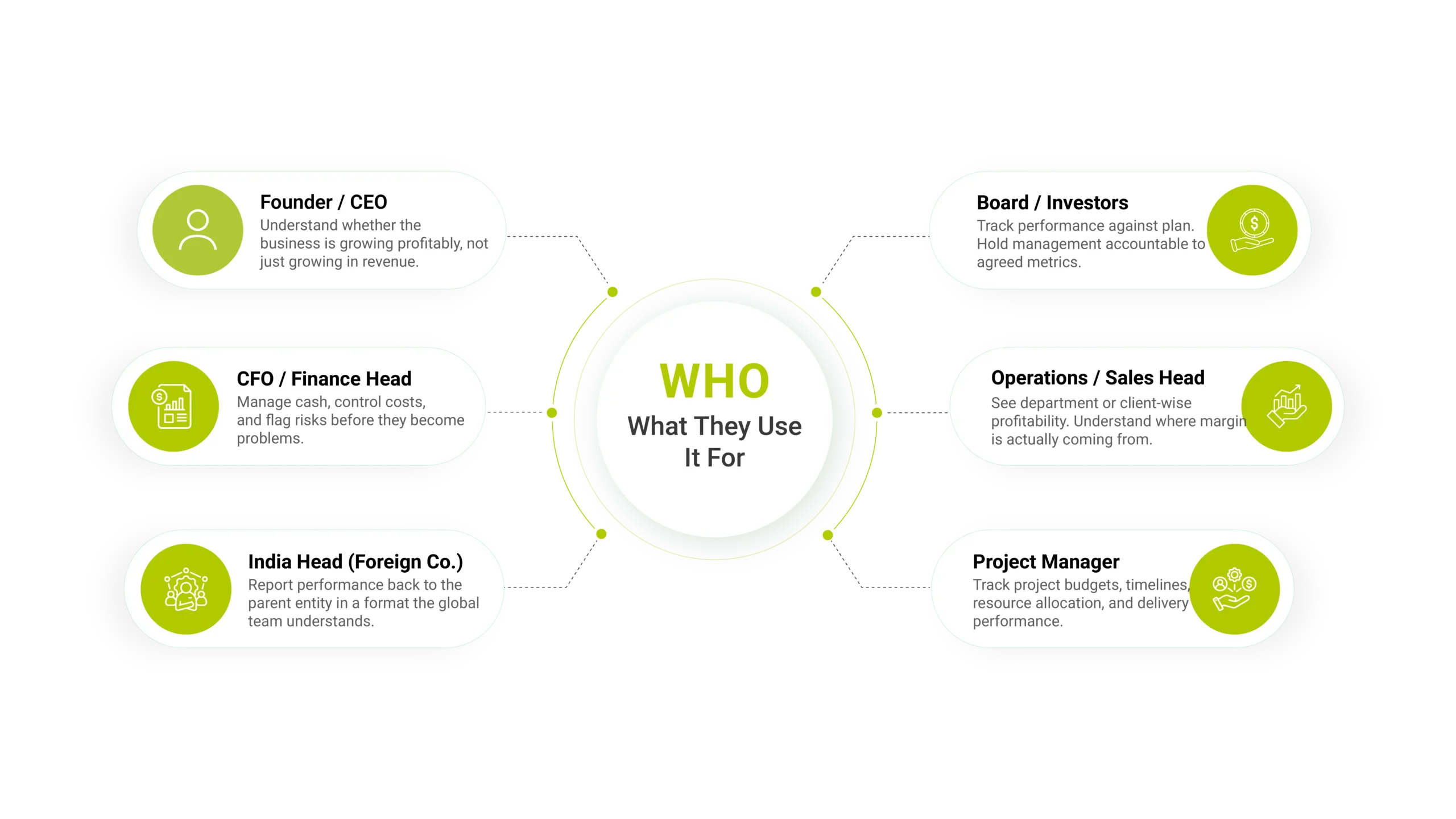
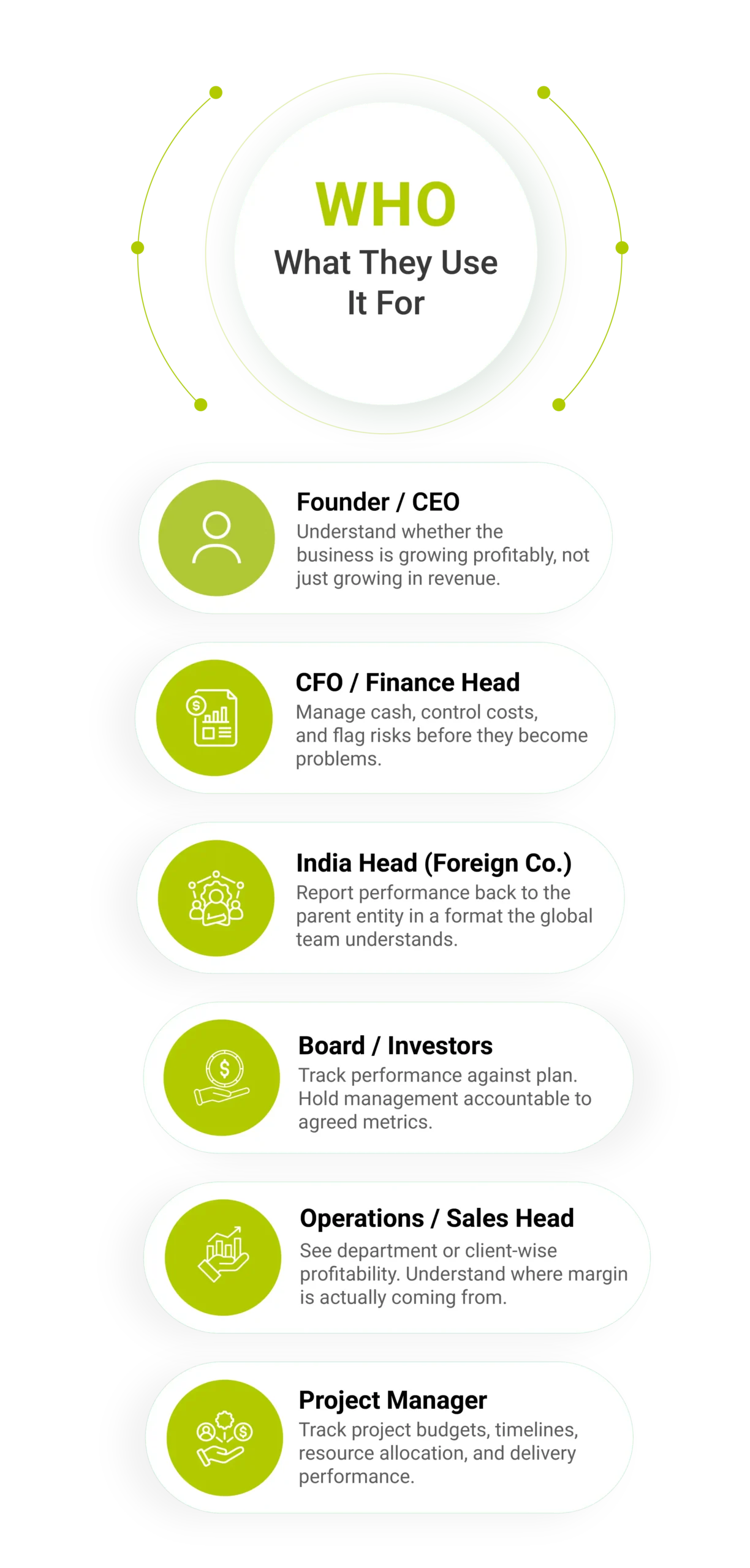
Reporting Is Only as Good as the Books Behind It.
MIS built on delayed or inaccurate books is not MIS. It is a well-formatted guess. This is why Greenvissage maintains both bookkeeping and reporting as a connected engagement. The accounts team and the reporting team are not separate. The same structured workflow that keeps your books clean feeds directly into your monthly MIS.
Clean books every month. Reliable reports every month. Always in sync.
How We Deliver Your Reports.
A four-step cycle. Every month. Without chasing
Close the Books
Month-end entries completed, accounts reconciled, books locked for the period.
Prepare Reports
Financial statements and MIS reports were prepared according to the agreed format and scope.
Review & Interpret
Key movements identified, variances flagged, narrative added where relevant.
Deliver & Discuss
Reports delivered within the agreed timeline. Available to walk through numbers with leadership if needed.

Still Have Questions?
At a minimum: P&L statement, balance sheet, cash flow statement, trial balance, and payables and receivables summaries. MIS outputs — budget vs actual, ageing reports, margin analysis, management dashboard — are agreed at the start of the engagement based on what your business needs.
Financial reporting covers statutory outputs — what happened, in a structured format required for compliance. MIS interprets that data for management — what changed, why it matters, and what needs attention. One is for the auditor. The other is for the boardroom.
Within 5–7 working days of the month close, provided books are current. If bookkeeping is also managed by Greenvissage, the two are handled as a connected workflow — so there is no lag between close and reporting.
Yes. Every engagement starts with an understanding of what leadership actually needs to track — by product, by client, by region, by cost centre. The format is built around your business, not a generic template.
For many businesses, a well-structured MIS combined with periodic advisory support covers what a full-time CFO would do around reporting and financial visibility. For businesses that need deeper strategic finance involvement, our Virtual CFO service is the next step.
Ready to See What Your Numbers Are Saying?
We’ll show you exactly what reporting and MIS can look like for your business.
Whether you need monthly financials, a full MIS dashboard, or both, we build it around what your leadership actually needs.
- Financial Reporting
- P&L & Balance Sheet
- MIS Dashboards
- Budget vs Actual
- Ageing Reports
- Management Packs