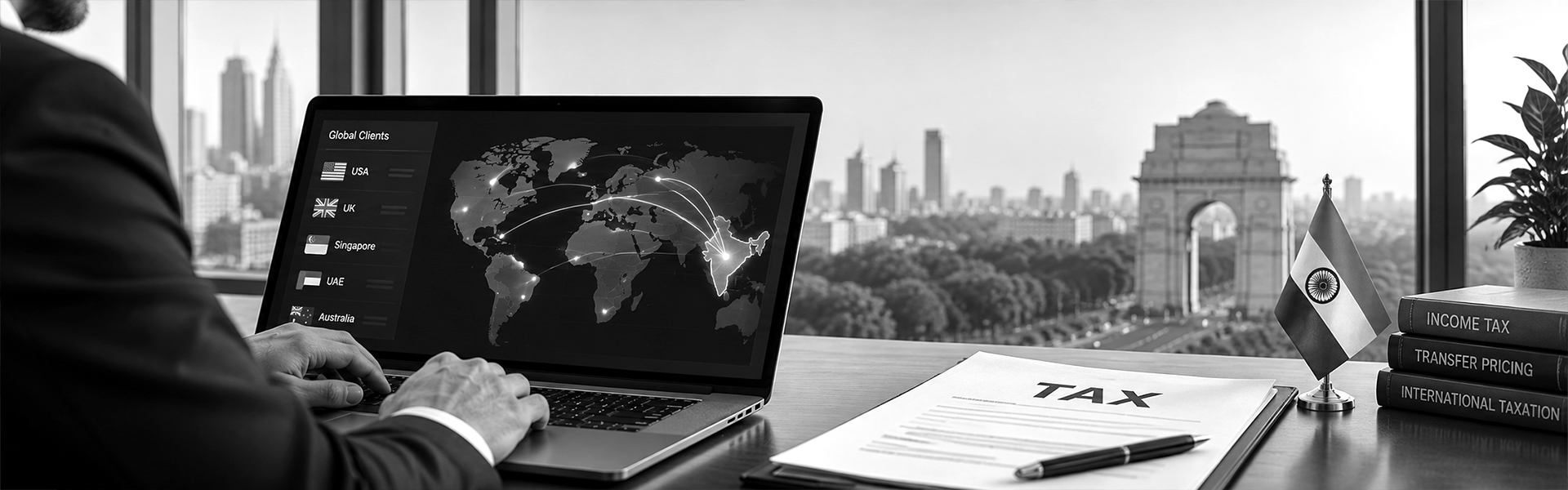
Place of supply is the GST rule that decides where a service is treated as delivered. That one decision determines who gets to tax it and, for a cross-border service, whether India taxes it at all. Two businesses doing similar work can end up with different GST outcomes purely because the law places their services in different locations. An Indian firm designing a website for a German client is likely to be zero-rated. An Indian firm running an event in Mumbai for that same client is not.
This piece covers how the GST rules work, which services follow different rules, and what changed in 2026 for intermediary services.
What Does Place of Supply Mean?
Every supply of a service has to be linked to a place for GST purposes. For domestic sales, that place decides which state collects the tax and whether it’s charged as CGST plus SGST or as IGST. For cross-border sales, it decides something bigger: whether the service counts as an export.
The rules split into two sets. Section 12 of the IGST Act covers cases where both the supplier and the recipient are in India. Section 13 covers cases where either one is outside India. This piece is about Section 13, since that’s the one overseas businesses and Indian exporters deal with.
What Is the Default Rule?
For most services, the place of supply is the location of the recipient, not the provider. Unless a service falls under one of the listed exceptions, this is the rule that applies.
Take an Indian design firm building a website for a client in Germany. The place of supply is Germany, which is outside India. If the other export conditions are met, the service can be zero-rated.
There’s one fallback. If the recipient’s location isn’t available in the ordinary course of business, the place of supply becomes the supplier’s location instead. In practice, this is a good reason to keep client addresses clearly recorded on contracts and invoices.
Which Services Follow Different Rules?
A short list of services skips the default rule and follows its own:
➡ Services tied to immovable property
The place of supply is where the property is located. This covers hotel stays, estate agents, and construction coordination, including architects and interior designers. An Indian architect designing a building in Mumbai for an overseas client is supplying the service in India, so it isn’t an export, even though the client sits abroad.
➡ Events and conferences
The place of supply is where the event is actually held. This covers admission to or organisation of cultural, sporting, educational, and entertainment events, along with conferences and exhibitions.
➡ Performance-based services
Services that depend on physical performance, such as work done on goods or with the recipient physically present, generally follow where they’re performed.
➡ Banking to account holders and short-term transport hire
These follow the supplier’s location. This applies to services from banks, financial institutions, and NBFCs to account holders, and to hiring means of transport (excluding aircraft and vessels) for up to one month.
Other categories, such as transportation and certain telecom services, have provisions of their own in Section 13. If a service isn’t clearly covered by the default rule, check the section text or ask an advisor before assuming zero-rating.
How Does Place of Supply Decide Export Status?
Place of supply is only one of five conditions a service has to meet to count as an export:
- The supplier is located in India
- The recipient is located outside India
- The place of supply is outside India
- Payment is received in convertible foreign exchange (or in rupees where RBI permits)
- The supplier and recipient are not merely establishments of a distinct person
Miss any one of these and zero-rating isn’t available. That’s how place of supply can quietly undo an export claim even when the client is overseas and paying in dollars.
Read More: To learn about the mechanics of claiming the benefit, including filing a Letter of Undertaking and claiming refunds, click here
What Changed for Intermediary Services in 2026?
An intermediary is a broker, an agent, or anyone who arranges or facilitates a supply between two or more other parties. It doesn’t include someone supplying on their own account.
Until recently, intermediary services were a specific exception. Their place of supply was fixed at the supplier’s location, whatever the recipient’s location. For an Indian firm arranging deals for overseas clients, that meant the service was treated as delivered in India. It had to charge 18% IGST and couldn’t claim export benefits. This became one of the most litigated issues in GST, and it hit IT and consulting firms, BPOs, marketing support businesses, and global capability centres.
The Finance Act, 2026, which received Presidential assent on 30 March 2026, omitted that clause. Intermediary services now follow the default rule, so the place of supply is the recipient’s location. A few points are worth noting:
- The change is prospective. Earlier periods aren’t rewritten, so past disputes rest on the arguments that existed at the time.
- The definition of “intermediary” hasn’t changed. Zero-rating still requires all five export conditions to be met.
- It cuts both ways. Indian businesses paying foreign agents or brokers now have to pay IGST at 18% under reverse charge on those payments, and issue a self-invoice.
How Do You Work Out Your Place of Supply?
Three questions get you to the answer:
1.Who is the recipient, and where are they located?
Use the location available in the ordinary course of business, such as the address on the contract or invoice.
2.Does the service fall under one of the exceptions?
Check for immovable property, events, performance-based services, banking to account holders, and short-term transport hire.
3.Do the other export conditions hold?
The supplier must be in India, payment must arrive in foreign exchange, and the two parties can’t be merely establishments of one person.
If the answer to the second question is no, the default rule applies and the place of supply is the recipient’s location.
Final Takeaway
The same service can be taxed or zero-rated depending on where the law places it. The default rule, the recipient’s location, covers most services, but a short list of exceptions can override it, and the 2026 change to intermediary services means older assumptions are worth rechecking. Before treating any cross-border service as an export, work out the place of supply first, then confirm the other four conditions.
FAQ'S
It’s the location where a service is treated as delivered for GST purposes, and it decides which tax rules apply. For cross-border services, the default is the recipient’s location, unless an exception applies.
Generally, it’s the client’s location, so a service to an overseas client is treated as supplied outside India. Exceptions apply for services tied to property, events, or physical performance, which follow where the property, event, or work is located.
They can be. The Finance Act, 2026 omitted the clause fixing their place of supply at the supplier’s location, so the default recipient-location rule now applies. Zero-rating still requires all five export conditions, including payment in foreign exchange.
Generally yes. Following the change to intermediary rules, Indian businesses paying foreign agents or brokers typically owe IGST at 18% under reverse charge and must issue a self-invoice. Confirm the operative date with an advisor.
If the recipient’s location isn’t available in the ordinary course of business, the place of supply becomes the supplier’s location instead. Keeping client addresses clearly recorded on contracts and invoices helps avoid this fallback.